

Lead Frontend Engineer
- Job ID
- 72732
- Category
- Enterprise Technology
- Location
- Chennai, India
- Work Type
- On-site
Description
- Own end-to-end frontend architecture for AI and Non-AI Platform products, defining patterns for streaming UI, real-time agent responses, tool-call visualization, citations/grounding display, and multi-turn conversational state.
- Define and enforce the frontend technology stack, coding standards, component architecture (design system), and state-management strategy across all AI Platform UI surfaces.
- Architect the integration layer between frontend applications and AI backend services (Vertex AI / Gemini, Google ADK agents, RAG pipelines, LangGraph/LangChain orchestrators) via secure, well-documented APIs (Fast/REST/GraphQL/WebSocket/SSE).
- Drive technical decisions on rendering strategy (SSR/CSR/ISR), edge/streaming delivery, performance budgets, and accessibility (WCAG 2.1 AA) for AI-heavy, latency-sensitive interfaces.
- Design and maintain the AI Platform's internal Developer Portal / Self-Service Console, enabling engineering teams to provision AI resources (RAG pipelines, agents, vector indices, environments) without manual tickets — extending self-service cloud infrastructure provisioning patterns into the UI layer.
- Build and version a reusable AI-UI Component Library / Design System (chat widgets, agent trace viewers, citation cards, feedback/human-in-the-loop widgets, prompt/response inspectors) consumable by multiple product squads across the enterprise as a shared platform capability.
- Define 'golden path' frontend templates and starter kits (Next.js/React + AI SDK boilerplate) so downstream product teams can spin up new AI-powered UIs in days, not weeks — a core platform-engineering productivity outcome.
- Own the frontend layer of platform Service Catalog entries (e.g., 'Conversational Agent UI', 'Document Intelligence Console') including golden-path templates, scorecards, and documentation, aligned to internal developer-platform (IDP) practices.
- Partner with platform/infra teams to expose infrastructure and model-routing configuration (e.g., cost-aware model selection between Gemini Flash/Pro) through simple, safe self-service UI controls rather than backend-only configuration.
- Establish frontend observability (RUM, tracing of AI response latency, token-stream monitoring) integrated with platform-wide SRE/observability tooling leveraging Dynatrace SaaS.
- Build production-grade full-stack features spanning UI, BFF (Backend-for-Frontend) layer, and orchestration services that call LLM/agent backends (Vertex AI Gemini, Google ADK multi-agent workflows).
- Implement secure, low-latency streaming pipelines (Server-Sent Events / WebSockets) for token-by-token AI responses, agent 'thinking' states, and tool-execution progress indicators.
- Integrate authentication/authorization (OAuth2 client credentials, API Gateway via Apigee X) into frontend session and API-call flows, ensuring B2B and B2E security compliance.
- Collaborate with backend/platform engineers on API contracts, chunking/retrieval metadata exposure (for citation rendering), guardrail/response-safety signal surfacing, and error/fallback UX for model or agent failures.
- Evaluate and select appropriate technologies and tools to support the development and deployment of products on the eCommerce foundation layer
- Collaborate with stakeholders to understand business needs and requirements, and translate them into technical and non-functional specifications
- Work with Product teams to understand their pain points and increase the Developer Experience through Platform Engineering Capabilities
- Strategize & work with senior leaders across Ford’s Enterprise Architecture, IT Operations to make significant, measurable impact on the eCommerce Platform
- Experience in Cloud FinOps to optimize Cloud Infrastructure Consumption Cost
Responsibilities
- AI-Native Chat & Agent UI: Production conversational interface with streaming responses, multi-agent trace visualization, citation/grounding display, and tool-call transparency, built with React 18+/Next.js (App Router, Server Components/Actions).
- AI SDK Integration Layer: Frontend integration React.js-Node.js (Typescript) / LangChain.js / Google ADK web clients for streaming completions, function-calling UI, and structured output rendering.
- Design System & Component Library: Versioned, themeable component library (Storybook-documented) with AI-specific components — chat bubbles, agent step timelines, feedback thumbs-up/down + RLHF capture widgets, prompt inspector, retrieval-source cards.
- Real-Time & Streaming UX: SSE/WebSocket-based streaming UI patterns, optimistic UI, token-level rendering, and graceful degradation/fallback states for model latency or failure.
- State Management: Robust conversation/session state handling using modern state libraries supporting multi-turn context and agent memory visualization.
- Accessibility & Performance: WCAG 2.1 AA compliant, Core Web Vitals-optimized AI UI, with performance budgets for time-to-first token and time-to-interactive.
- Testing Suite: Component (Jest/RTL), E2E (Playwright) test suites including deterministic mocking strategies for non-deterministic LLM outputs.
- Developer Self-Service Portal UI: Internal web console for provisioning AI resources, viewing agent/RAG pipeline health, and managing environment configs, aligned to Cloud Platform self-service provisioning.
- BFF / API Layer: Backend-for-Frontend service (FastAPI / Node.js) mediating between UI and AI backends, handling auth, request shaping, response streaming, and caching.
- Agent & RAG Orchestration Integration: Full-stack wiring to Google ADK multi-agent workflows (intent classification, routing, guardrails) and Vertex AI RAG Engine / Gemini for grounded, cited retrieval-augmented responses.
- Vector Search & Retrieval UI-to-Backend Contract: End-to-end pipeline exposing embeddings/vector search results (BigQuery, Vertex Vector Search) with chunk-level metadata surfaced in the UI for source citation.
- Secure API Gateway Integration: Full-stack OAuth2 (client-credentials) authentication flows through Apigee X / API Gateway, including token refresh, session handling, and role-based UI rendering.
- Cost-Aware Model Routing UI: Full-stack feature exposing dynamic LLM routing (e.g., Gemini Flash vs. Pro) based on query complexity, with a UI toggle/telemetry dashboard for cost and latency visibility.
- Deployment on Kubernetes (GKE): Containerized frontend and BFF services with CI/CD pipelines (GitHub Actions/Cloud Build), deployed via GKE with progressive delivery (canary/blue-green) and environment promotion aligned to platform standards.
- Observability & Feedback Loop: Full-stack telemetry capturing latency, token usage, guardrail triggers, and user feedback, feeding back into model/prompt evaluation dashboards.
- Reference Architecture & Golden Path Repo: A reusable, documented starter template (frontend + BFF + agent integration) published to the internal platform catalog for rapid onboarding of new AI product teams.
- Platform-as-a-Product mindset: Define and track adoption, developer satisfaction (DevEx/NPS), and time-to-first-deploy metrics for teams consuming the AI UI SDK/component library.
- Service Catalog ownership: Publish and maintain frontend 'golden path' templates as catalog entries (e.g., via Backstage-style internal developer portal) with clear SLAs, ownership, and versioning.
- Self-Service Enablement: Extend self-service cloud infrastructure provisioning into the presentation layer — enabling product teams to self-provision chat UIs, agent consoles, and dashboards without platform-team tickets.
- Reusability & Multi-Tenancy: Architect UI components and BFF services to be multi-tenant and configuration-driven so multiple business units/products can adopt the same platform UI foundation.
- Governance-as-Code: Embed responsible-AI, security, and accessibility guardrails directly into shared components and CI pipelines so consuming teams inherit compliance by default.
- Platform Roadmap & Feedback Loops: Run regular platform reviews with consuming teams to prioritize the AI-UI roadmap, deprecations, and versioning strategy.
BE Computer Science Engineering
8+ Years Experience
Frontend, Self-service and Platform Engineering
-
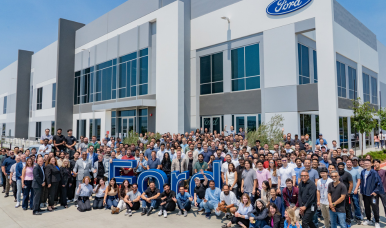
Built on one bold idea and the passion to define sustainable transportation for generations to come, Ford is a story about people with a vision that’s still being written.
What We Do -

Ford’s culture fuels the kind of momentum where ideas flow, progress is unstoppable, and our people keep redefining what it means to innovate.
Our People and Culture -

At Ford, your work matters, your life matters and we’re here to back the whole you—from growth to well-being—so you show up ready to realize your full potential.
Your Benefits
Jobs For You.
Explore roles tailored to your interests, based on your preferences and experience.
-
Hardware & Mechanical Engineering - Early Career Program, Advanced EV
- Long Beach, California
-
Lead Frontend Engineer
- Chennai, India
-
Process Coach
- Hermosillo, Mexico
-
Engineering Specialist, Industrial
- Dearborn, Michigan